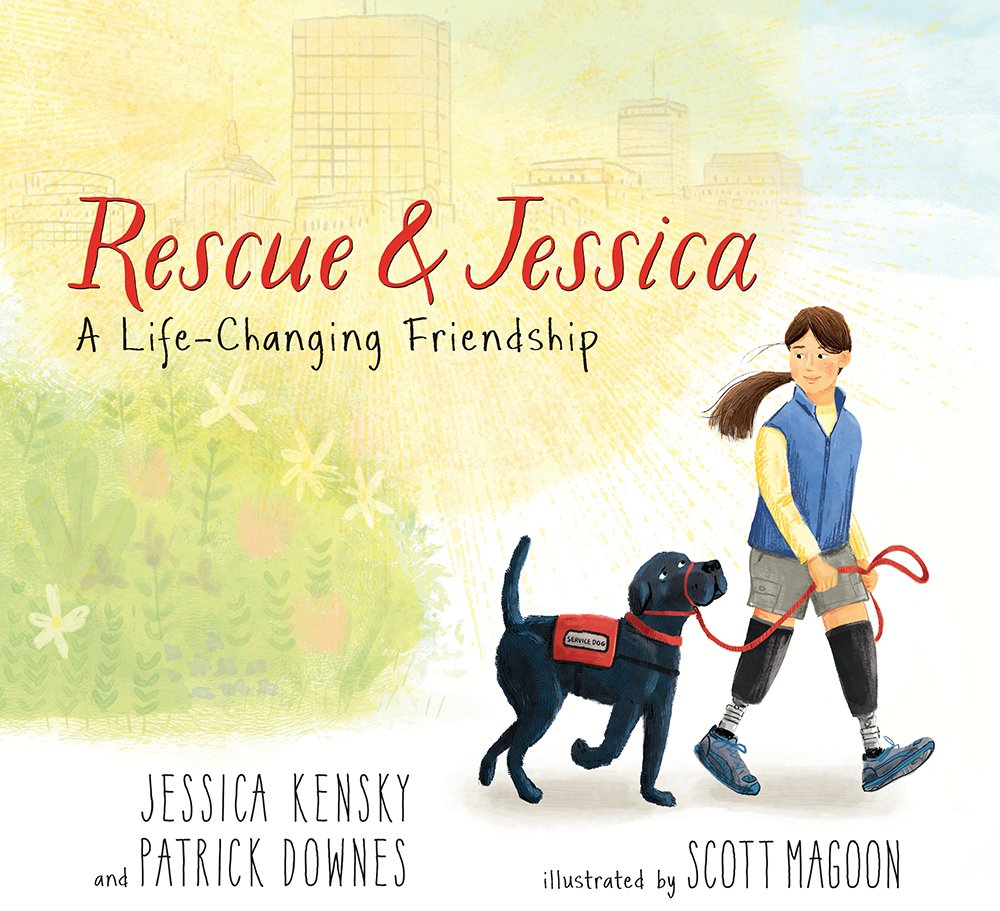
Back in February, I had the opportunity to meet Jessica Kensky (along with Rescue) and Patrick Downes, the authors of Rescue and Jessica: A Life-Changing Friendship. This week I had the great pleasure of hosting Jessica, Patrick, and Rescue at my school to read their story with one of my third grade classes.


 Kensky and Downes have channeled their real-life experiences and emotions allowing readers to feel, not just see, how Jessica's life changes when she gets her service dog, Rescue (whose life also changes).

Scott Magoon's art has a lightness and softness, yet is realistic. From hospital settings to life with Rescue, Magoon shows the fine details, as with the medical equipment, including wheel chairs, prosthetic devices, and physical therapy settings. Effective use of white space frames the scenes and invites further inspection.
 His art shines a light, literally, on Jessica's emotional journey, from the darker shaded spreads where she is dealing with the removal of her lower leg to the sunlight filled spreads where hope exists and when Rescue comes into her life.


The Rescue and Jessica book tour starts in April, if they are in your area, you should go!


Rescue and Jessica: A Life-Changing Friendship is about parallel journeys that intersect just when it is needed. Rescue, a service dog is on a new path to help others. Jessica, a young girl who is injured, and, like Kensky, ultimately becomes a double amputee, is on a path of healing. The book is about how the lives of a service dog who needs a job and a girl who needs a service dog come together.
As with Kensky, the Jessica of the story finds hope, freedom, and a return to normalcy when she receives her service dog, Rescue, who, in turn, finds purpose. It's a life-changing friendship. Here's a trailer for the book:
Promotional material for the book states: "...the heartening story of the love and teamwork between a girl and her service dog will illuminate and inspire." Illuminate and inspire this book does, in many ways, just like the authors.

Through spare text, Kensky and Downes tell Rescue and Jessica's journey from both perspectives. We see how these two are made for each other. Rescue's voice brings a lightness to the story, yet he is serious about training for the job ahead of him. Kensky and Downes convey in straight forward and clear language the experiences the young girl is going through, deftly covering aspects like becoming an amputee. Their narrative engenders compassion, not pity, in the reader.


Being in my library when authors are reading their books to my students is always an incredible experience - the privilege to witness the connection that reader and writer make. The visit from Jessica Kenksy, Patrick Downes, and Rescue was this and so much more.
I visited this classroom of third graders a few days before to explain that they were going to have a special author visit. I explained that the book is about a young girl who has a similar disability as one of the authors, the girl has to have both of her legs removed below the knee. "Rescue and Jessica: A Life -Changing Friendship is about a young girl and a service dog whose lives intersect at just the right moment. The young girl has injuries and has to have both of her legs removed (amputated) below the knee. Rescue becomes Jessica's service dog and helps her rebuild her life."
I asked the students about the Boston Marathon. How many watch it? How many have friends and family who run it? I then explained that our authors had been hurt during the bombing at the Marathon almost five years ago and that the story is based upon Jessica's own experiences after the bombing.
We then watched the book trailer that I posted above.
I wanted my students to see Jessica and Rescue doing the things they do together. It was easy to show some footage of them at home and at the park because Rescue won the ASPCA Dog of the Year and there is a video about them. I started the video at about 45 seconds to skip past the footage from the bombing.
The students loved seeing Rescue get a tissue or a blanket for Jessica. They also loved seeing them out playing in the park.

Fast forward three days and Jessica, Patrick and Rescue were in the house! They read their book, with Patrick reading Rescue's journey and Jessica her own. As you can see, it was a wonderful read aloud experience.


After reading their book, Jessica and Patrick invited the students to share comments or ask questions.

The comments affirmed my feelings about this book. Students felt the book was a little sad, but not too sad, and more hopeful and inspiring than anything else. The students loved how Patrick voiced Rescue's part. They also demonstrated their visual literacy skills by talking about the effective use of color in the artwork (shout out to Scott Magoon!).
The questions demonstrated the natural inquisitiveness of children and also indicated that they are focused on the practicality of life as an amputee as opposed to focusing on what happened before. They loved Rescue and asked many questions about him and what he likes to do.
One student asked why they had not included the Marathon bombing. Patrick's answer was perfect. He shared that that was just seconds of their life, that these last five years are what is important as are the life ahead of them.
Patrick asked why the students thought they had made the girl in the story young and not an adult like Jessica, someone quickly answered that it was easier for the students to connect with the young girl because she is their age. I say this often, but children are deep thinkers and keen observers.
The students noticed the little boy with the fire truck throughout the book. Patrick explained that that is his cameo in the book. When asked why they thought he carried a fire truck, the students remembered that Rescue was named after a fire fighter. Deep thinkers and keen observers.

I had reminded students that Rescue would be working when they visited and that we needed to respect his job and give him space, you will notice that they took this part seriously.

For the visit, I received an early copy of the book from Candlewick. I wanted to share my experiences reading the book with students with Jessica and Patrick, so I read the book with my fifth graders, which was the only grade I saw before their visit. After we read Rescue and Jessica: A Life-Changing Friendship, I invited the students to leave comments or questions if they wanted to, they did.
Comments


Questions


I plan to bring Jessica, Rescue, Patrick, and hopefully Scott back to our school for all of our students in grades one through five. You'll likely hear about it here.
More Information:
For those of you not familiar with the book, here's the publisher's description:
Rescue thought he’d grow up to be a Seeing Eye dog — it’s the family business, after all. When he gets the news that he’s better suited to being a service dog, he’s worried that he’s not up to the task. Then he meets Jessica, a girl whose life is turning out differently than the way she’d imagined it, too. Now Jessica needs Rescue by her side to help her accomplish everyday tasks. And it turns out that Rescue can help Jessica see after all: a way forward, together, one step at a time. An endnote from the authors tells more about the training and extraordinary abilities of service dogs, particularly their real-life best friend and black lab, Rescue."


